
DUB-DUB.ai vs Sonix: Transcription, Subtitles, and Localisation Workflows
AI transcription tools are now a standard part of content production workflows. Teams use them to turn audio and video into text for editing, search, and publishing. Sonix and DUB-DUB.ai are two such audio transcription tools.
Sonix is one of the established platforms in this space. It focuses on transcription, transcript editing, and subtitle export.
DUB-DUB.ai is built around a broader workflow that extends from transcription into subtitles, translation, and localisation.
While both tools overlap in core transcription capabilities, they are often used in different parts of the content production process.
What Sonix Does Well
Sonix is designed around fast and structured transcription workflows.
Users typically upload audio or video files and receive a timestamped transcript that can be edited directly in the browser.
Common Sonix use-cases include:
- AI transcription for audio and video
- Speaker identification and diarisation (also speaker tagging, or who-said-what)
- Browser-based transcript editing
- Subtitle export (SRT, VTT)
- Transcript translation
- Searchable transcript libraries
- Collaboration across teams
Sonix is often used when the transcript itself is the main output.
Its editor allows users to click directly on words and jump through the audio, which makes reviewing and correcting transcripts straightforward.
Where Sonix May Not Fit Every Workflow
Sonix is primarily built around transcription and transcript management.
For many users, this is sufficient, especially when the transcript is the final deliverable.
However, in workflows where content continues beyond transcription, additional steps are often required.
For example:
- Subtitle refinement and timing adjustments
- Translation review across multiple languages
- Managing subtitle versions for different platforms
- Localisation workflows across multiple outputs
- Speaker-based subtitle formatting at scale
In these cases, transcription becomes only the first step in a longer production process.
How DUB-DUB.ai Approaches These Workflows
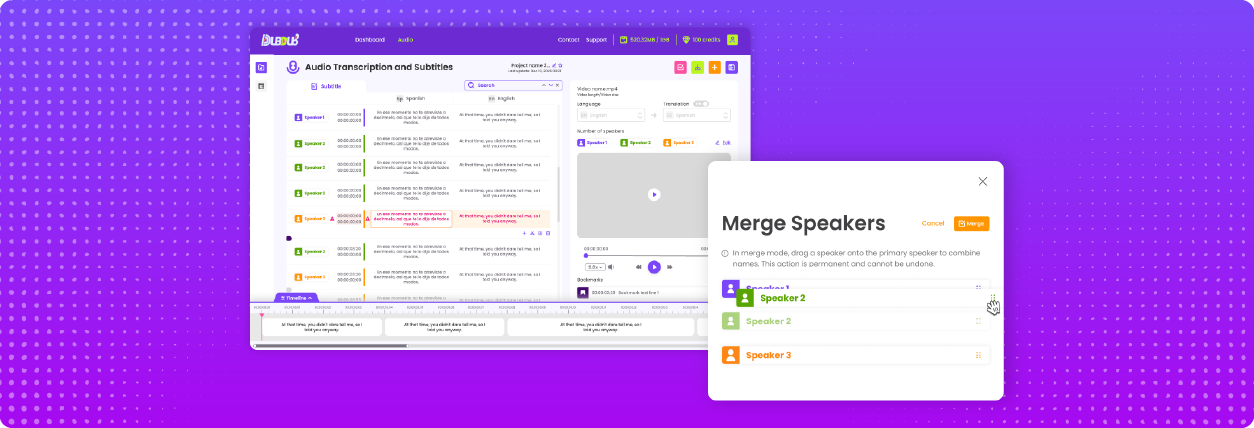
DUB-DUB.ai is designed for workflows that extend beyond transcription.
Instead of stopping at the transcript, it focuses on turning spoken content into publish-ready assets.
This typically includes:
- AI transcription
- Subtitle generation
- Subtitle editing
- Speaker diarisation (also speaker tagging, or who-said-what)
- Browser-based subtitle editing
- Translation workflows
- Multilingual subtitle production
- Export-ready video and caption files
- Export as subtitle (SRT) or transcript (Word DOCx)
- Strictly no sharing of data
- Strictly no training of LLMs
This structure is aimed at teams producing content across multiple languages or platforms.
Real-World Workflow Comparison
Podcast Production
Sonix is often used when the main requirement is an accurate transcript for:
- Show notes
- Articles and summaries
- Content archiving
- Searchable audio libraries
DUB-DUB.ai may be used when the same content is also repurposed into:
- Subtitle clips
- Social video content
- Translated versions for different audiences
Research and Interviews
Sonix fits well when interviews are transcribed and reviewed as text.
Common needs include:
- Speaker identification
- Searchable transcripts
- Timestamp navigation
DUB-DUB.ai can do the same, and may be more relevant when interviews need to be:
- Translated
- Published as subtitles
- Distributed across multiple languages
Webinars and Training Content
Webinars often require both internal documentation and external publishing formats.
Sonix is commonly used for transcript generation and review.
DUB-DUB.ai is often used when subtitles and multilingual outputs are part of the publishing workflow.
Feature Comparison
|
Feature |
DUB-DUB.ai |
Sonix |
|
AI Transcription |
✓ |
✓ |
|
Speaker Diarisation |
✓ |
✓ |
|
Transcript Editing |
✓ |
✓ |
|
Subtitle Generation |
✓ |
✓ |
|
Subtitle Editing |
✓ |
✓ |
|
Translation Support |
150+ Languages |
50+ languages |
|
Multilingual Localisation Workflow |
✓ |
Partial |
|
Browser-Based Editor |
✓ |
✓ |
|
Timeline editor |
✓ |
Limited |
Who Should Choose Sonix?
Sonix is often suitable for users who need:
- Transcript-focused workflows
- Interview and research transcription
- Searchable audio/video libraries
- Direct transcript editing in the browser
- Subtitle export for downstream use
It is commonly used where transcription is the main output.
Who Should Choose DUB-DUB.ai?
DUB-DUB.ai can do the same as Sonix, and is often used by teams that need:
- Transcription as part of a larger workflow
- Subtitle creation and editing
- Translation across multiple languages
- Speaker-aware captioning
- Multilingual content production
- Subtitle timeline editing
It is designed for workflows where transcription is only the starting point.
Final Verdict
Sonix remains a well-established transcription platform used across research, media, and business workflows.
It is often a strong fit when the primary goal is generating and managing transcripts.
DUB-DUB.ai is the new kid on the block and focuses more on the downstream workflow after transcription, including subtitles, translation, speaker diarisation, and localisation.
The better choice depends on the role transcription plays in your process.
If transcription is the final output, Sonix is often sufficient.
If transcription is part of a broader multilingual content workflow, DUB-DUB.ai may be more suitable.