A missed caption can change the meaning of a quote, a product demo, or a legal recording. That is why choosing an automatic subtitle generator for videos is not just about speed. It is about accuracy, control, and whether the tool fits the way you actually work.
Most teams do not want a giant post-production system. They want to upload a file, get usable subtitles fast, make a few edits, export in the right format, and move on. Creators want to publish faster. Marketers want broader reach. Journalists, researchers, and legal teams want reliable text without handing sensitive material to a platform that treats uploads as training data.
What an automatic subtitle generator for videos should actually do
At a basic level, the job sounds simple: turn speech into timed text. In practice, there is a lot packed into that sentence. A good tool has to recognize spoken words accurately, handle different accents, separate speakers when needed, time captions correctly, and produce exports you can use without extra cleanup.
That is where many tools start to split apart. Some are fast but sloppy with punctuation and timing. Some handle short social clips well but struggle with long interviews or meetings. Some look cheap upfront, then charge extra for translation, exports, team access, or language support.
A useful subtitle generator should cover the whole workflow. You upload audio or video, the platform creates subtitles automatically, you review the text, fix any edge cases, and export to formats that fit your editing or publishing stack. If you also need transcripts or translated subtitles, that should feel like the same job, not a separate product with a separate bill.
Speed matters, but accuracy matters more
If you are captioning ten short videos a week, saving a few minutes on each file adds up quickly. But speed without accuracy creates a different kind of waste. Every bad name, broken sentence, or mistimed caption has to be fixed manually. That can erase the time savings that automation promised in the first place.
The real test is not whether a platform can generate subtitles in a minute. The real test is how much work is left after that minute. For clean audio, modern tools can do very well. For noisy environments, overlapping speakers, technical terminology, or fast back-and-forth dialogue, quality varies a lot.
This is where expectations should stay realistic. No automatic subtitle generator for videos will be perfect on every file. If your source audio is poor, the output will reflect that. But strong software should still get you close enough that editing feels like review, not full reconstruction.
Privacy is not a side feature
For some users, subtitles are about convenience. For others, they involve confidential interviews, internal meetings, legal evidence, research recordings, or unreleased media. In those cases, privacy is not a nice extra. It is a buying requirement.
A lot of AI tools make this part fuzzy. They talk about intelligence and automation but say very little about what happens to uploaded files. That is a problem. If your team handles sensitive material, you need a clear answer on data use, retention, and whether your content is used to train models.
The better standard is simple: your content is yours. Full stop. If a provider cannot state that clearly, the platform may be fine for low-risk social content, but it is not the right fit for confidential work.
This is one reason straightforward tools are winning over bloated suites. When the product is built around media processing, not data extraction, trust becomes easier to evaluate. You know what you are paying for and what the service is supposed to do.
The pricing trap most buyers notice too late
Subtitle software often looks affordable until your usage grows. Then the add-ons show up. Per-seat fees. Premium export formats. Translation locked behind a higher tier. Usage caps that force upgrades long before you need more features.
For creators and lean teams, that kind of pricing causes friction. For larger organizations, it makes forecasting harder than it should be. An hour of media should have a clear cost attached to it. If the math only makes sense after reading four pricing pages, the model is working for the vendor, not for you.
That is why usage-based pricing remains one of the cleanest approaches for subtitle generation. You pay for the media you process, not for inflated feature bundles or a growing list of users. It is easier to justify, easier to budget, and easier to scale.
A flat hourly rate is especially useful when subtitles are just one part of a wider workflow that may also include transcripts, speaker identification, and multilingual delivery. Everything stays predictable.
Who benefits most from automatic subtitles
The obvious answer is video creators, but the use cases go much wider than that. Marketing teams use subtitles to improve completion rates and make clips usable without sound. Journalists use them to speed up review and quoting. Researchers use them to turn recorded material into searchable text. Legal and compliance teams use them to document spoken content more efficiently.
There is also a practical accessibility case. Many viewers watch videos muted by default, especially on social platforms and mobile devices. Subtitles help content perform in those environments, but they also make material more usable for people who are deaf or hard of hearing, non-native speakers, and anyone watching in a noisy setting.
The key point is that subtitles are no longer a finishing touch. For many teams, they are part of the default publishing workflow.
What to look for before you commit
An automatic subtitle generator for videos should save effort, not create a new admin job. That means the basics need to be strong. Uploading should be simple. Editing should be fast. Exports should work with common formats like SRT and VTT. If your team works across markets, translation support should be built in, not awkwardly bolted on.
Language coverage also matters more than many buyers expect. If you only publish in English, this may seem secondary. But global teams, multilingual creators, and cross-border businesses often need subtitle and transcript translation on short notice. A tool that supports 150+ languages gives you room to expand without replacing your workflow later.
It is also worth checking whether the platform supports speaker identification. That may sound more relevant to transcripts than subtitles, but it helps during review, especially in interviews, panels, and recorded meetings.
And then there is the interface. If your editor needs a training session, the product may be overbuilt for the job. Good subtitle software should feel obvious after the first upload.
Simplicity beats feature clutter
There is a common mistake in this category: confusing more features with more value. Most users do not need a sprawling media suite with ten tabs and enterprise jargon. They need accurate output, quick edits, flexible exports, and confidence that their files are handled properly.
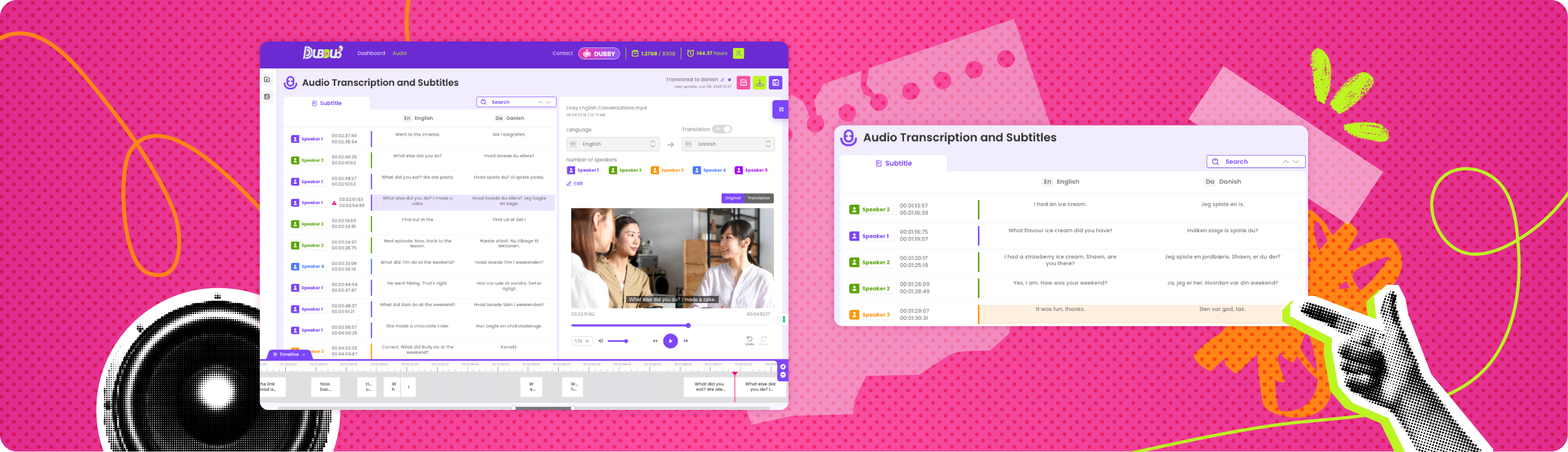
That is where a focused platform stands out. Dub-Dub, for example, keeps the promise tight: transcripts, subtitles, translations, speaker identification, privacy-first handling, and clear pay-as-you-go pricing. No seat-based sprawl. No mystery costs. No data-training catch hiding behind the UI.
That kind of discipline matters because subtitle generation is usually not the final goal. The final goal is publishing, reviewing, localizing, documenting, or delivering content faster. The software should help you get there without becoming the project.
The trade-off to keep in mind
There is no single best subtitle tool for every situation. If your team needs frame-level finishing for broadcast delivery, you may still want specialist review in the loop. If your files contain heavy jargon, multiple overlapping speakers, or poor audio, editing time will still matter. Automation reduces effort. It does not eliminate judgment.
But for most real-world workflows, the value is already clear. A strong automatic subtitle generator for videos can cut hours of manual work, lower localization costs, and make content usable by more people in more places. The right one does that without complicated pricing, without friction, and without treating your uploads as raw material for someone else’s model.
That is the standard worth holding. If a platform gives you speed, usable accuracy, broad language support, and real privacy, it is not just helping you add captions. It is helping you move faster without giving up control.