
DUB-DUB.ai vs AssemblyAI: API Transcription, Speech Intelligence, and Workflow Comparison
Speech-to-text tools typically fall into two categories: end-user content platforms and API-first infrastructure tools.
AssemblyAI sits in the API-first speech-to-text category.
DUB-DUB.ai sits in a transcription and localisation workflow focused on subtitles, translation, and structured content outputs, though it also offers API connection through MCP.
Both handle transcription, but they operate at different layers of the workflow stack.
What AssemblyAI Does Well
AssemblyAI is an API-based speech-to-text and audio intelligence platform.
It is used when transcription and speech processing need to be embedded into systems or products rather than edited in a standalone interface.
Common capabilities include:
- Speech-to-text API for audio and video
- Speaker diarisation output
- Real-time and batch transcription
- Timestamped transcripts
- Audio intelligence features (summaries, topics, sentiment)
- Developer SDKs and documentation
- Scalable processing infrastructure
AssemblyAI is typically used as a backend layer for audio processing.
Where AssemblyAI May Not Fit Every Workflow
AssemblyAI is designed as infrastructure rather than a content production tool.
In workflows that require direct editing, subtitle management, or multilingual publishing, additional tools are usually needed.
For example:
- Subtitle editing and timing adjustments
- Translation workflows across multiple languages
- Visual review of transcripts and captions
- Content formatting for publishing platforms
- End-to-end localisation workflows in one interface
In these cases, AssemblyAI functions as a processing layer rather than a complete production environment.
How DUB-DUB.ai Approaches These Workflows
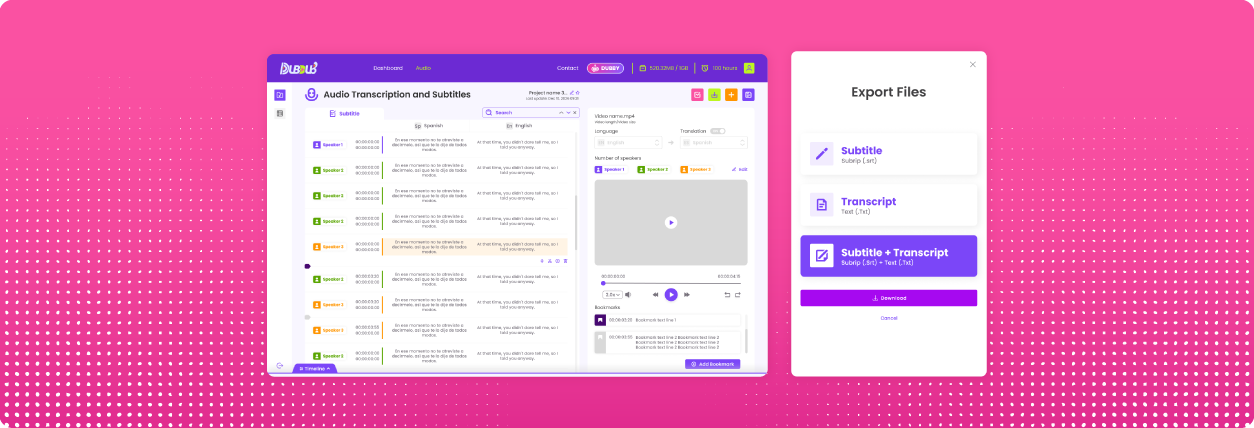
DUB-DUB.ai is built for structured transcription workflows that extend into subtitles and localisation.
Instead of providing an API layer, it focuses on turning spoken content immediately into editable and publishable assets, offering an easy to use interface.
This includes:
- AI transcription
- Speaker diarisation (speaker tagging or “who-said-what”)
- Subtitle generation
- Subtitle editing workflows
- Translation of transcripts and subtitles
- Multilingual content preparation
- Export-ready caption and subtitle files
DUB-DUB.ai is used when transcription is part of content creation and publishing rather than system integration.
Real-World Workflow Comparison
Product and Engineering Use Cases
AssemblyAI is used when transcription is embedded into applications or systems.
This includes:
- Adding speech-to-text into SaaS products
- Processing large audio datasets
- Building audio intelligence features
- Automating transcription pipelines
DUB-DUB.ai is not typically used in this context.
Content Production Workflows
DUB-DUB.ai is used when spoken content is turned into publishable assets.
This includes:
- Subtitle creation and editing
- Speaker-aware transcription
- Translation for multiple languages
- Reuse of content across platforms
AssemblyAI may sit upstream in the pipeline, but editing and publishing usually require additional tools.
Audio Intelligence Workflows
AssemblyAI is often used for extracting structured insights from audio.
This includes:
- Topic detection
- Sentiment analysis
- Summarisation
- Structured audio processing pipelines
DUB-DUB.ai focuses on output and publishing rather than audio analytics.
Feature Comparison
|
Feature |
DUB-DUB.ai |
AssemblyAI |
|
AI Transcription |
✓ |
✓ |
|
Speaker Diarisation |
✓ |
✓ |
|
Subtitle Generation |
✓ |
API output |
|
Subtitle Editing |
✓ |
— |
|
Translation Support |
✓ |
— |
|
Multilingual Localisation Workflow |
✓ |
— |
|
Speech-to-Text API |
✓ (via MCP) |
✓ |
|
Audio Intelligence Features |
— |
✓ |
|
Developer SDKs |
— |
✓ |
|
End-User Editing Interface |
✓ |
— |
|
MCP |
✓ |
✓ |
Who Should Choose AssemblyAI?
AssemblyAI is suitable for teams that need:
- Speech-to-text via API
- Transcription embedded into products
- Scalable audio processing infrastructure
- Audio intelligence for analytics or automation
- Developer-first integration workflows
It is used as an infrastructure layer rather than a content tool.
Who Should Choose DUB-DUB.ai?
DUB-DUB.ai is suitable for teams that need:
- Structured transcription workflows
- Subtitle editing and refinement
- Speaker-aware transcript outputs
- Translation across multiple languages
- Localisation-focused content production
- Publish-ready subtitle and transcript assets
It is used for content creation and distribution workflows.
Final Verdict
AssemblyAI is an API-first speech-to-text and audio intelligence platform designed for developers building transcription into systems and applications.
It is commonly used as infrastructure for speech processing and audio analysis.
DUB-DUB.ai focuses on the downstream workflow, including transcription, subtitles, translation, speaker diarisation, and localisation.
The choice depends on where transcription sits in the workflow.
If transcription is part of a product or backend system, AssemblyAI is typically the right layer.
If transcription is part of a content production and publishing workflow, DUB-DUB.ai is more suitable.