A leaked interview, an unreleased podcast episode, a legal deposition, a customer call - once that file leaves your hands, trust gets expensive. That is why picking a private ai transcription tool is not a minor software decision. It is a workflow decision, a compliance decision, and sometimes a reputation decision.
Most transcription tools promise speed and accuracy. Fewer are clear about what happens to your data after upload. That gap matters. If you work with sensitive recordings, source material, internal meetings, or embargoed media, privacy is not a nice extra. It is part of the product.
What a private AI transcription tool should actually protect
Privacy claims can get vague fast. Some platforms say they are secure when they really mean they use standard hosting and encrypted transfer. That is table stakes. A true private ai transcription tool should answer a tougher question: who can access your files, how long are they stored, and are they used to train models?
That last point is where many buyers should slow down. If your content is used for AI training, your upload is no longer just a transaction. It becomes input for someone else’s system. For journalists, legal teams, healthcare-adjacent operations, research groups, and brand teams handling unreleased campaigns, that is a problem.
A useful privacy standard is simple: your content is processed to deliver your transcript, subtitles, or translation, and not repurposed beyond that. No vague language. No hidden trade.
Why privacy matters more than people think
Transcription sounds operational. In practice, it touches some of the most sensitive information organizations hold. Recorded interviews may include anonymous sources. Sales calls include customer details. Internal meetings reveal strategy, hiring plans, or financial updates. Video drafts contain unreleased launches. Even creator content can carry private sponsor terms or personal information.
If a tool gets the words right but mishandles the file, it fails the job.
This is also where smaller teams get caught off guard. Enterprises usually have procurement and security review. Independent producers, startups, and agencies often do not. They need tools that are private by default, not private only after a long sales process.
The five checks that matter before you upload anything
1. Data training policy
Start here. Does the provider explicitly say your files are not used to train AI models? If the answer is buried, qualified, or missing, assume the policy is not in your favor.
This is one of the clearest dividing lines in the market. A no-data-training promise tells you the company sees your media as your property, not as raw material.
2. Storage and retention
Ask how long files and generated outputs are stored. Some users need longer retention for team workflows. Others want quick deletion. Neither is universally right. What matters is control and clarity.
If you handle sensitive files, short retention windows and straightforward deletion options are often better than a platform that keeps everything forever because it is convenient.
3. Access controls
Who inside the vendor organization can access uploaded media? The answer should be tightly limited. This matters for client work, legal review, and internal governance.
Security language without practical access limits is incomplete. Privacy depends as much on process as on infrastructure.
4. Accuracy in real-world audio
Privacy is essential, but the transcript still needs to be useful. Look for speaker identification, subtitle generation, and support for multilingual content if your workflow depends on them. A private tool that creates hours of cleanup work is not efficient.
Accuracy also depends on your source material. Clear interviews, webinars, and studio audio are easier than crosstalk, field recordings, or low-volume calls. Any honest evaluation should account for that.
5. Pricing that does not punish scale
A lot of transcription software gets expensive in confusing ways. Seat limits, feature gating, and unclear usage caps can make a simple task feel like enterprise procurement.
Usage-based pricing is often the cleaner option, especially for freelancers, growing teams, and organizations with uneven monthly volume. You pay for the work done, not for a stack of restrictions.
The trade-off: privacy, speed, and convenience
There is always some balance to manage. A private ai transcription tool may offer stricter retention and tighter controls, while a mass-market app may optimize for broad integrations and viral adoption. One is not automatically better than the other. It depends on your files and your risk.
If you transcribe public-facing content with low sensitivity, convenience might carry more weight. If you process interviews, internal recordings, legal material, or multilingual media tied to client confidentiality, privacy should move to the top of the list.
That is why broad claims like best transcription tool are not very helpful. Best for what? Best for whom? Best under which constraints? The right tool is the one that fits your actual workflow without forcing you to compromise on the parts that matter most.
What professionals should expect from a modern tool
A strong transcription platform should not make you choose between simplicity and control. You should be able to upload a file, get a transcript quickly, identify speakers, generate subtitles, and translate content without hunting through a maze of settings.
That matters for creators trying to publish faster. It matters for media teams localizing video at scale. It matters for legal and research users who need a dependable text record without sending material through bloated systems.
A practical standard looks like this: fast processing, accurate output, support for many languages, export options that fit editing and publishing workflows, and a privacy posture that is easy to verify. Everything you need. Nothing you do not.
A private AI transcription tool is not just for regulated industries
It is easy to assume privacy only matters for law firms or large companies. That misses how much confidential media is handled by everyday teams.
Agencies manage prelaunch assets. Podcasters record off-the-record discussions before editing. Startups transcribe investor updates and product meetings. Journalists protect source conversations. Researchers work with interviews that should not circulate beyond the project. Even solo creators often sit on raw footage that is far more sensitive than the polished final version.
In all of those cases, privacy is not a luxury feature. It is basic respect for the content and the people in it.
Where many tools fall short
Some products are built to impress in a demo, not to hold up in daily use. They stack on features, add pricing tiers, and position privacy as a premium add-on. That approach creates friction where users need clarity.
The better path is simpler. Clear upload. Clear output. Clear policy. Clear price.
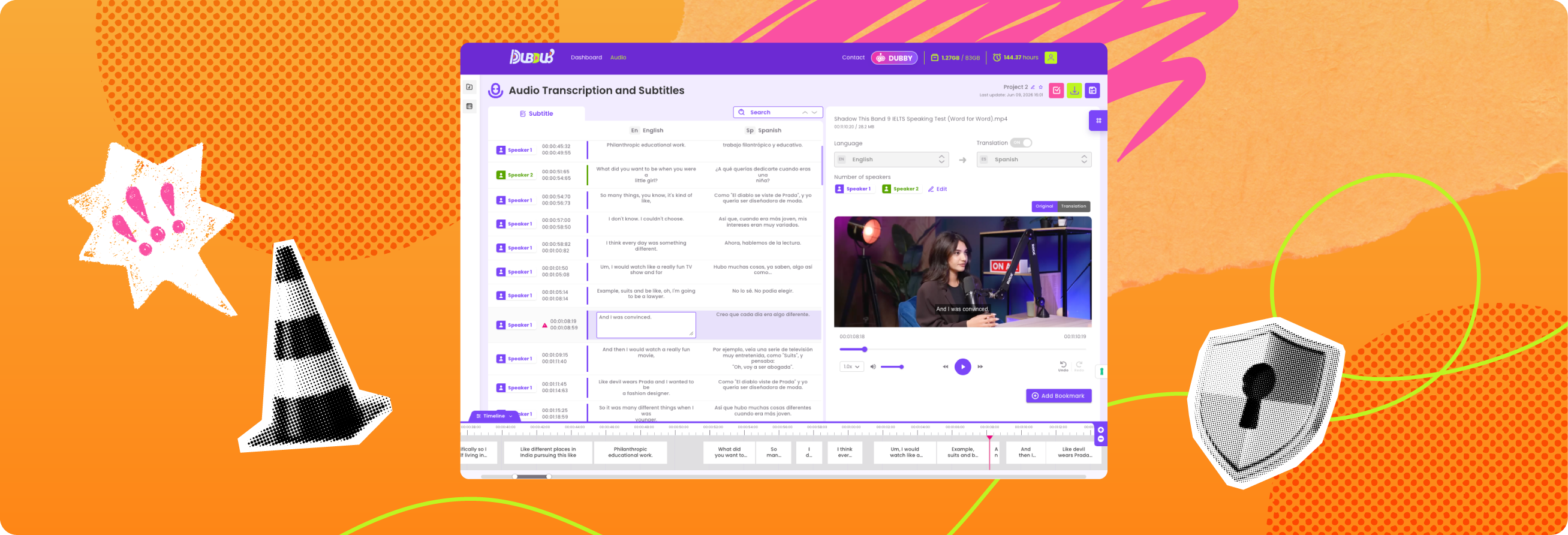
That is the appeal of platforms like Dub-Dub. The value is not abstract. Fast transcription, subtitles, translation in 150+ languages, and a direct no-data-training stance make the product easier to trust. The flat hourly pricing helps too. You know what the work costs before you commit.
How to make the final decision
Do not choose based on marketing adjectives. Choose based on operational facts.
Read the privacy policy. Check whether files train models. Look at retention terms. Test a real file, not a perfect sample. See how well the tool handles speaker changes, accents, and noisy audio. Confirm export formats match how your team works. Then look at cost over a month or quarter, not just the first upload.
If a provider makes these answers hard to find, that tells you something. Confidence shows up as clarity.
The real standard is trust under pressure
Anyone can look good when the file is a clean podcast intro and nothing sensitive is on the line. The real test is whether you would use the same platform for a confidential board meeting, a protected interview, or a client recording you cannot afford to mishandle.
That is the standard worth using. Not hype. Not feature sprawl. Not vague promises about security.
Pick the tool that treats your content like it belongs to you, keeps the workflow fast, and charges in a way that makes sense. When transcription becomes part of serious work, privacy is not extra. It is the baseline.