A missed quote, a mislabeled speaker, or a leaked recording can cost more than the transcript itself. That is why ai audio and video transcription is no longer a nice extra for creators and teams. It is now part of the production workflow, the compliance workflow, and in some cases, the risk management workflow too.
The market is crowded, but most buyers are not asking complicated questions. They want to know if the transcript is accurate enough to use, fast enough to matter, affordable enough to scale, and private enough to trust. Everything else is secondary.
What AI audio and video transcription actually solves
At a basic level, transcription converts spoken content into text. That sounds simple until you apply it to real work. Podcasts need searchable show notes. Marketing teams need subtitles for short-form clips. Journalists need interviews turned into usable copy. Legal and research teams need speaker-separated transcripts they can review, quote, and archive.
Manual transcription still has a place when every word must be verified line by line. But for most workflows, the bigger problem is time. A one-hour recording can take several hours to transcribe and clean up by hand. AI cuts that delay dramatically, which changes the economics of content production and documentation.
That speed matters most when transcription is not the final output. Usually, it is the starting point. Once you have text, you can edit faster, create subtitles, translate into other languages, extract quotes, repurpose content, and make archives searchable. The transcript becomes the raw material for everything that follows.
Where AI audio and video transcription succeeds - and where it still needs help
AI transcription is very good at turning clear speech into draft-ready text. It performs especially well on interviews, webinars, meetings, podcasts, lectures, and recorded presentations with decent audio quality. If speakers are paced well and background noise is under control, the result can be strong enough for immediate publishing after a light review.
But there are trade-offs. Heavy accents, overlapping speakers, poor microphones, crosstalk, technical jargon, and noisy environments still create errors. Speaker identification can be excellent in one file and messy in another. Subtitle timing can be solid for social clips but need polishing for long-form content with fast dialogue.
That does not mean the technology falls short. It means buyers should stop expecting magic and start evaluating fit. If you need courtroom-level precision on chaotic audio, human review still matters. If you need to process a backlog of interviews, courses, product demos, or multilingual media quickly, AI is often the obvious choice.
Accuracy is not just one number
Many platforms talk about accuracy as if it were fixed. It is not. Accuracy depends on the audio, the speakers, the language pair, the formatting rules, and what you plan to do with the output.
For example, a content team creating subtitles for YouTube has a different standard than a legal team reviewing recorded testimony. One may accept minor punctuation fixes. The other may need timestamps, speaker labels, and much stricter wording. A generic accuracy claim tells you very little unless you know the use case.
A better question is this: how much editing will the transcript require before it is useful? That is the real productivity test. A fast transcript that needs ten minutes of cleanup can still be a huge win. A cheap transcript that needs an hour of correction is not cheap at all.
Privacy is the real buying decision for many teams
This is where the category separates quickly. Plenty of tools can transcribe. Fewer can do it without raising uncomfortable questions about what happens to the files after upload.
For creators, journalists, researchers, and businesses handling internal calls or sensitive interviews, privacy is not a feature add-on. It is the baseline. Source material may include unreleased campaigns, legal discussions, private customer information, or confidential reporting. If uploaded content is reused to train models or retained without clear limits, the risk is obvious.
That is why no-data-training policies matter. So does plain language about ownership, retention, and processing. Buyers are getting more disciplined here, and rightly so. If the platform is vague, assume the trade-off is not in your favor.
Your content is yours. Full stop. That standard should not be treated as premium positioning. It should be normal.
Speed matters, but workflow fit matters more
Fast processing is valuable, but only if the output is usable. Teams do not need another file to babysit. They need transcripts, subtitles, and translations that fit directly into production.
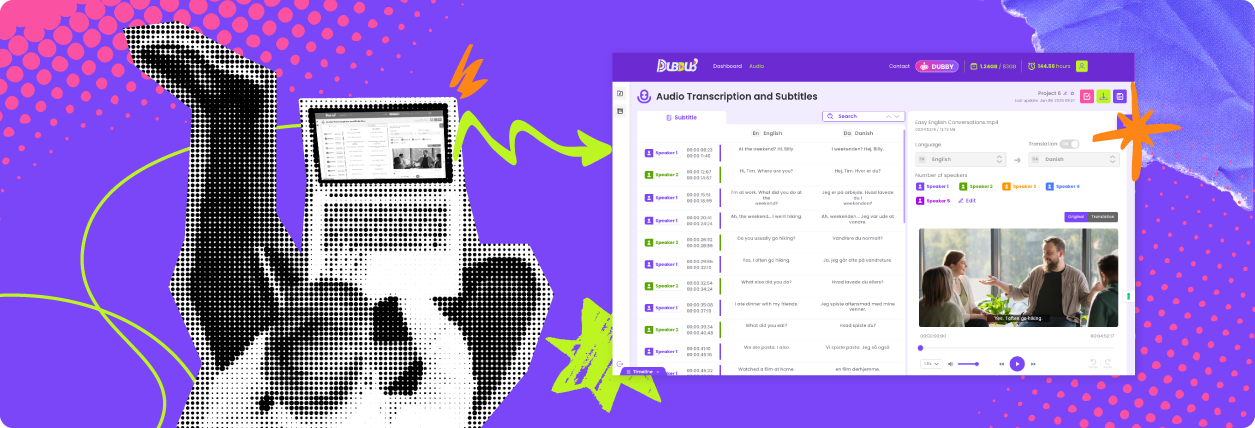
That means practical details matter. Can you identify speakers clearly? Can you export in the formats your editor, producer, or compliance team actually uses? Can you generate subtitles without adding another tool? Can you translate transcripts and subtitles into multiple languages without rebuilding the workflow from scratch?
This is where streamlined platforms have an edge. Simplicity is not a cosmetic benefit. It reduces handoff friction, training time, and mistakes. If a creator can upload a file, get a transcript, generate subtitles, translate them, and export quickly, that is not just convenient. It is operationally better.
Cost is often where good tools become bad decisions
A lot of transcription pricing is built to look flexible while staying hard to predict. Seat-based plans, feature gates, usage tiers, and vague overage rules make budgeting harder than it needs to be.
That may work for bloated enterprise software. It does not work for teams that simply want to process media without getting locked into a contract maze.
Usage-based pricing is often the cleaner model, especially for independent creators, startups, and teams with fluctuating volume. You pay for what you process. No seat tax. No paying for unused capacity. No surprise upgrade because one extra collaborator needed access.
Predictable hourly pricing is even better because it maps directly to the job. If you process ten hours, you know the cost. If you process one hundred, you know that too. For buyers comparing AI to manual services or agency outsourcing, that clarity matters.
Multilingual work changes the value of transcription
The old model was simple and slow. First transcribe. Then subtitle. Then send the text out for translation. Then reformat everything for distribution. Each step added cost and delay.
AI has changed that. Once speech is converted into structured text, translation and subtitle generation become much faster. That matters for media teams publishing globally, educators reaching broader audiences, and brands localizing product videos or webinars.
Still, translation quality depends on context. Straightforward spoken content usually translates well. Humor, slang, niche technical language, and brand-specific phrasing may need review. The value is not that AI removes humans from the process. It removes the repetitive groundwork so teams can focus on the parts that actually need judgment.
What to look for in an AI audio and video transcription platform
The best platform is not the one with the longest feature list. It is the one that handles the full job with the least friction.
Look for strong core transcription, speaker identification, subtitle generation, transcript and subtitle translation, and export options that fit your workflow. Then look harder at pricing transparency and privacy posture. If those two areas are weak, the rest does not matter much.
Ease of use should also rank higher than many buyers think. A powerful tool that slows down non-technical users becomes a bottleneck. Most teams do not need enterprise theater. They need results.
That is the lane where products like Dub-Dub make sense. Fast outputs, clear pricing, broad language support, and a no-data-training position solve the real objections buyers have without adding complexity they did not ask for.
The smart way to evaluate before you commit
Use your own files. Test clean audio, messy audio, multiple speakers, and at least one file with terminology specific to your field. Measure output quality, but also measure editing time. Check subtitle readability, speaker separation, translation quality, and export flexibility.
Then review the privacy terms with the same seriousness you apply to the transcript itself. If your recordings are sensitive, this is not administrative fine print. It is part of product performance.
The right tool should make you faster on day one, not after a week of onboarding. It should also make scaling feel boring in the best way. Upload, process, export, move on.
AI transcription is no longer impressive because it exists. It is impressive when it saves time, protects the source, keeps costs clear, and gives you outputs you can actually use. That is the standard worth buying against.