A witness interview lands in your inbox at 6:12 p.m. Trial prep starts tomorrow. The recording contains names, strategy, and facts that cannot leak. That is where secure transcription for legal recordings stops being a nice-to-have and becomes a basic operating requirement.
Legal audio is different from general business audio. It carries privilege concerns, chain-of-custody questions, confidentiality obligations, and real consequences if the wrong person gains access or the transcript gets key language wrong. Speed matters, but not at the expense of control. If your team is handling depositions, client interviews, hearings, internal investigations, or recorded statements, the transcription process needs to protect the file from upload to export.
What secure transcription for legal recordings actually means
Security is not just encryption on a marketing page. For legal work, it means the recording stays protected at every stage, access is limited to the right people, and the transcript can be reviewed without creating more risk than the original file.
That starts with the basics. Files should be encrypted in transit and at rest. Access should be restricted by role, not shared casually through open folders or email attachments. Retention should be clear, not indefinite by default. And the provider should be explicit about what happens to uploaded content.
One point matters more than many teams realize: your recordings should not be used to train someone else’s AI model. If a platform treats uploads as free training data, that is not a small policy detail. For legal teams, it is a red flag.
Accuracy belongs in the security conversation too. An insecure transcript can expose data. An inaccurate transcript can distort meaning, trigger bad legal analysis, or create downstream review problems that waste hours. Secure transcription is not only about keeping outsiders out. It is also about producing text your team can trust enough to work from.
Why legal teams have a higher bar
A marketing team can survive a messy transcript. A law firm or in-house legal department often cannot. Legal recordings are full of overlapping speakers, low-quality audio, crosstalk, interruptions, jargon, and names that standard speech tools routinely mishandle. Add tight deadlines and multiple reviewers, and the risk compounds fast.
There is also the issue of exposure. Legal recordings often contain personal data, financial details, health information, employment issues, or allegations that have not been tested in court. That makes every upload decision a governance decision.
The practical standard is simple: if you would not send the recording through an unsecured email thread, you should not upload it to a transcription tool with vague privacy terms, weak account controls, or unclear retention rules.
The biggest risks in legal transcription workflows
Most security problems do not start with a dramatic breach. They start with routine convenience.
A paralegal sends an MP3 through a personal file-sharing app because the approved tool is slow. A contractor downloads a transcript to an unmanaged laptop. A team stores final text in a shared folder long after the matter closes. None of this looks unusual in the moment. Together, it creates unnecessary exposure.
Then there is vendor risk. Some transcription platforms are built for volume and growth first, governance second. They may offer attractive pricing upfront but hide critical details about data usage, storage duration, subcontractors, or human review. If the provider cannot explain its privacy model in plain English, that is a problem.
Legal teams should also watch for hidden workflow friction. If the platform is hard to use, people route around it. That is how shadow processes start. Security that slows everyone down too much does not hold for long.
How to evaluate a secure transcription provider
Start with data handling. Ask whether uploaded audio or video is ever used for model training. Ask how long files are retained and whether deletion is under your control. Ask where the data is stored and who can access it internally.
Next, look at access. A secure platform should make it easy to limit who sees what. Not every case file should be visible to every user. Role-based access, auditability, and controlled sharing are not enterprise extras in legal work. They are table stakes.
Then assess output quality. Legal teams need speaker identification that holds up under review, not just rough text blobs. They need timestamps when context matters. They need export options that fit existing review workflows. A transcript that requires heavy cleanup is not cheap if it burns billable time.
Finally, look at pricing. Predictable cost matters more than many vendors admit. Legal departments and firms need to budget cleanly, especially when transcription volume spikes during investigations or active litigation. Per-seat confusion and hidden overages create friction for no reason.
Balancing AI speed with legal-grade caution
AI transcription is fast. That is the point. But speed without governance is a shortcut to risk.
The better approach is to use automation for first-pass transcription, then apply human review where the stakes demand it. That might mean attorney review for witness language, paralegal review for formatting and names, or targeted correction of disputed passages. Not every minute of every file needs the same level of scrutiny. It depends on the use case.
For internal meetings about routine matters, a fast, private transcript may be enough with light edits. For a recorded statement or deposition prep file, your review threshold should be higher. The key is having a tool that gets you close quickly without compromising confidentiality before review even begins.
This is where simplicity helps. A platform that is easy to upload to, easy to review in, and easy to export from is more likely to be used correctly. That matters as much as any security claim on a feature page.
Secure transcription for legal recordings in real workflows
In practice, legal teams need more than a transcript. They need a workable record.
For depositions and interviews, speaker labeling helps reviewers trace statements quickly. For hearings and case prep, timestamps make it easier to verify critical exchanges against the source audio. For multilingual matters, translation may be necessary, but that introduces another layer of sensitivity. If translation is part of the workflow, it should happen inside the same controlled environment where possible, not through a patchwork of tools.
Export flexibility matters too. Some teams want plain text for case notes. Others need subtitle files for video evidence review or transcript formats that move cleanly into internal systems. A secure process should not force awkward format workarounds that push users into less controlled apps.
The best legal workflows are boring in the best way. Upload. Transcribe. Review. Export. Delete when appropriate. No unnecessary steps. No mystery about where the data went.
What good looks like from a privacy-first platform
A privacy-first transcription platform should be direct about its boundaries. Your files are processed for your output, not repurposed for model training. Pricing should be easy to understand. Features should solve real workflow problems, not pad a sales deck.
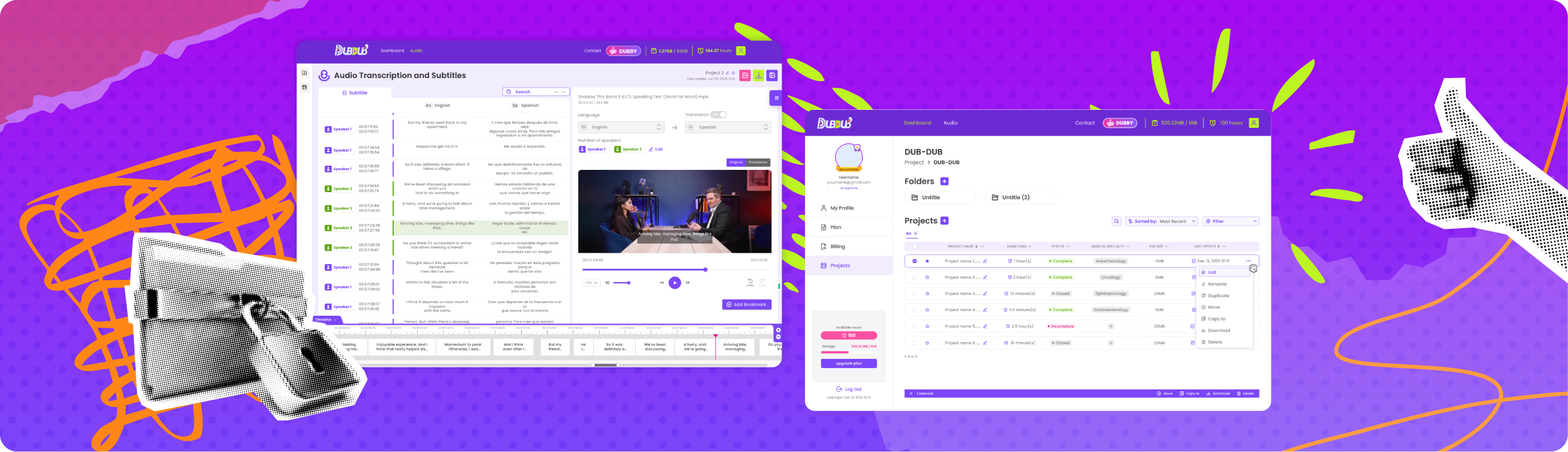
That is why many teams now favor tools that combine automated transcription, speaker identification, subtitle and transcript translation, and straightforward exports in one place. When the product removes friction, compliance gets easier to maintain.
Dub-Dub fits that model well because the value proposition is simple: fast language processing, flat pricing, and a clear no-data-training stance. For legal teams and adjacent professionals who need confidentiality without enterprise bloat, that combination is practical, not flashy.
The trade-off to think about before you choose
No transcription setup eliminates judgment. Even the most secure platform cannot decide which recordings should be retained, who should review sensitive passages, or whether a near-verbatim transcript is sufficient for the task. Your internal process still matters.
But the right tool changes the baseline. It reduces exposure, cuts manual time, and makes it easier for teams to stay inside approved workflows instead of improvising under pressure.
If you handle legal recordings regularly, do not evaluate transcription as a convenience feature. Evaluate it like part of your case workflow. Because it is. And when the recording is sensitive, the safest process is usually the one your team can use quickly, afford easily, and trust without second-guessing every upload.