A weekly podcast, a stack of interview recordings, a single legal deposition, a month of product demos - most teams do not need another subscription. They need a pay as you go transcription service that works when there is work, stays out of the way when there is not, and does not turn a simple upload into a pricing negotiation.
That is the real appeal of usage-based transcription. You pay for the audio or video you process. No seat math. No annual contract disguised as a discount. No paying full freight during slow months. For creators, agencies, researchers, and internal teams, that model is often the difference between a useful tool and shelfware.
What a pay as you go transcription service actually solves
The problem is not just cost. It is mismatch.
A lot of transcription platforms are built like enterprise software first and transcription tools second. They push users into plans with feature gates, team limits, and unclear overages. That can make sense for very large organizations with stable volume and procurement cycles. It is a poor fit for everyone else.
A pay as you go transcription service fixes that mismatch by aligning pricing with actual use. If you process three hours this month, you pay for three hours. If you process three hundred, you pay for that. The model is simple, which matters more than most vendors admit.
Simple pricing does two things. First, it makes budgeting easier. Second, it reduces hesitation. Teams stop delaying uploads because they are trying to preserve credits, dodge upgrade thresholds, or guess what counts as a billable action. When cost is predictable, work moves faster.
Why subscriptions often break in real workflows
On paper, subscriptions look efficient. In practice, audio and video workflows are uneven.
A journalist may need heavy transcription support during reporting cycles and almost none between projects. A marketing team might batch webinars and customer interviews around launches. A legal team may have spikes tied to case activity. Startups often need transcripts one week, subtitles the next, and nothing the week after.
Flat monthly plans can punish that variability. You either overpay during quiet periods or underbuy and hit limits when work shows up. Neither is efficient.
There is also the seat problem. Many tools charge by user even when the core cost driver is media volume. That inflates spend without adding real value. If five people need access to the same transcription workflow, paying for five seats on top of usage can feel like paying twice.
Usage-based pricing is not always cheaper in every scenario. If your organization processes a huge, steady volume every month, a negotiated enterprise contract may beat pay-as-you-go rates. But for a large middle ground of users, flexible billing is the more rational choice.
What to look for in a pay as you go transcription service
Not all pay-as-you-go offers are equal. Some are only flexible at the surface and complicated underneath.
Start with pricing clarity. You should be able to understand what one hour of media costs before you upload anything. If a service makes you calculate usage through feature bundles, premium language add-ons, or export restrictions, it is not actually simple.
Then look at turnaround time. Fast transcription matters, but speed without usable output is not enough. You want accurate transcripts, speaker identification where relevant, and exports that fit your workflow. If you still need to spend an hour reformatting every file, the headline speed is less impressive.
Should you operate in a certain domain, such as medical communications or the pharmaceutical industries, it may be worth it to consider a domain-specific transcription tool such as CORTiX.io.
Privacy is the next filter, especially for teams handling interviews, internal meetings, legal recordings, patient communications, or unreleased media. A low price does not mean much if your data is being retained too long, used for model training, or processed with vague policies. Your content is yours. Full stop.
Language support also matters more than many buyers expect. Even if your current need is English transcription, multilingual subtitles and translation can become a growth lever fast. One platform that handles transcripts, subtitles, and translation cleanly is usually better than stitching together separate tools.
Cost efficiency is not just about the lowest rate
The cheapest transcription option can be the most expensive one after delays, editing time, and policy risk.
Manual services may still make sense for highly sensitive, highly technical, or court-critical work where human review is non-negotiable. But for many business and creator workflows, modern AI transcription is accurate enough to save serious time at a fraction of the cost.
That is where a clear usage model stands out. A flat per-hour rate is easier to trust than pricing that changes based on feature access, storage thresholds, or account size. It also makes it easier to explain software spend internally. Finance teams like predictability. Operations teams like not having to ask permission every time they need a transcript.
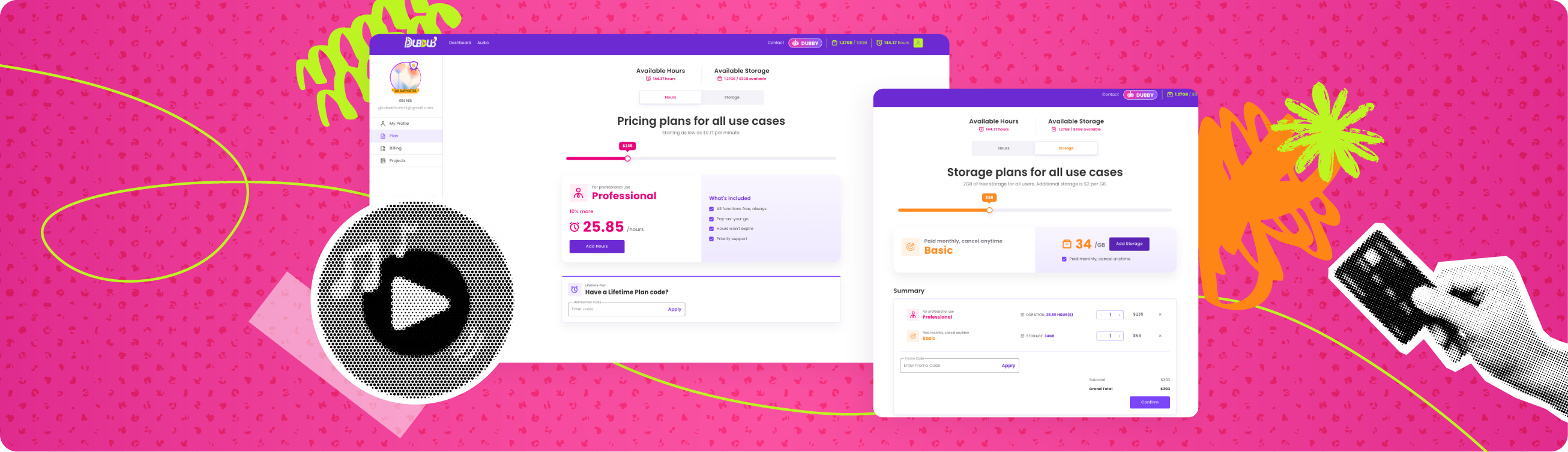
For example, DUB-DUB uses a flat $10 per hour model. That kind of pricing removes guesswork. You know what the job will cost before you start, which is rare in a category crowded with fine print.
Privacy is not a bonus feature
Transcription platforms process some of the most sensitive material a business creates. Client calls. Research interviews. Legal discussions. Internal strategy meetings. Source recordings. Product roadmaps.
That means privacy should not be buried in a trust page that appears after purchase. It should be central to the buying decision.
A serious service should be clear about how your files are handled, whether uploaded data is used for AI training, and what controls exist around retention and access. This is not just a concern for regulated industries. Creators, agencies, and startups have confidentiality risks too. An unpublished interview or campaign asset can be just as sensitive as a formal record.
There is a practical angle here as well. Teams move faster when they trust the tool. If staff hesitate to upload files because the platform feels opaque, work slows down and shadow processes appear. People start using personal tools, downloading files locally, or passing media around insecurely. A privacy-first platform reduces that friction.
Speed matters, but usable output matters more
A transcript is only valuable if it fits what happens next.
For creators, that may mean turning long-form video into captions, clips, show notes, and translated subtitles. For researchers, it may mean searchable transcripts with speaker labels. For legal and compliance teams, it may mean consistent formatting and reliable exports. For marketers, it may mean getting a webinar transcript cleaned up fast enough to repurpose into campaign assets the same day.
This is where many tools fall short. They can generate text, but they do not support the real production path after transcription. A stronger service handles the full chain: transcript creation, subtitle generation, translation, speaker identification, and practical export options.
That breadth matters because every handoff adds time and failure points. Fewer tools, fewer conversions, fewer surprises.
When pay-as-you-go is the wrong choice
It is worth being honest about trade-offs.
If you have a fixed, very high monthly volume and procurement demands a single annual contract, pay as you go may not be your best fit. If every file requires line-by-line human verification for evidentiary use, a specialized human service may still be the right call. And if your team needs deep custom workflow integrations today, you may need to compare platform maturity beyond pricing alone.
But those are specific cases. For everyone else, especially teams with mixed workloads, variable upload volume, or a strong need to control costs, usage-based transcription is often the cleaner model.
The better question to ask before you buy
Do not ask only, what is the transcription rate?
Ask whether the service respects your budget, your time, and your data. Ask whether pricing stays simple as your needs expand from transcripts to subtitles and translation. Ask whether your team can start using it immediately without training, procurement delays, or plan upgrades.
A good pay as you go transcription service does not make itself the project. It helps you process media, publish faster, and keep sensitive content under control. That is the standard that matters.
If your work with audio and video comes in waves, the smartest tool is usually the one that charges when you need it, stays predictable when you use it, and never asks you to compromise on privacy just to get the transcript done.