If you're comparing DUB-DUB.ai vs notta.ai, you're probably not looking for abstract feature grids. You want to know which tool gets your audio or video processed fast, what it will cost, and whether your files stay yours.
That is the real buying decision. For creators, media teams, researchers, legal users, and growing companies, transcription software is not just about turning speech into text. It affects publishing speed, multilingual reach, editing time, and data risk. So this comparison stays focused on what matters in actual workflows.
DUB-DUB.ai vs Notta.ai at a glance
Both platforms help turn spoken content into usable text. Both are built around AI transcription. Both can save serious time compared with manual work. But they are not optimized for the same buyer.
Notta.ai is often positioned as a meeting and note-taking tool. That makes it appealing if your main job is capturing conversations, syncing notes, and organizing spoken information from calls. Its strength is usually on the collaboration and meeting documentation side.
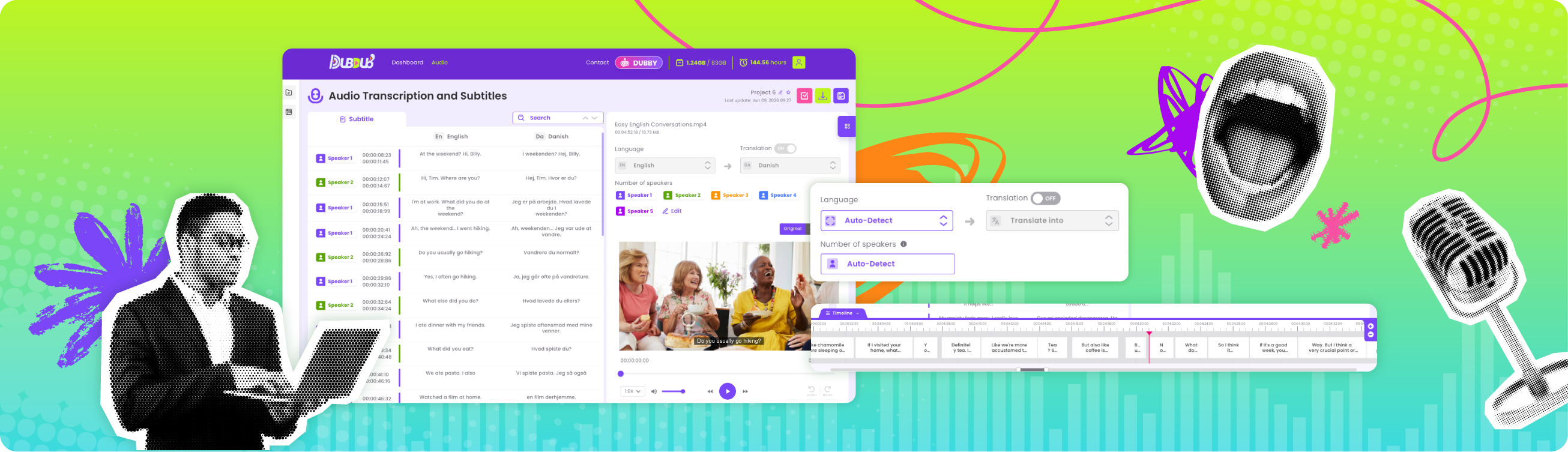
DUB-DUB takes a more direct media-processing approach. The focus is transcription, subtitles, speaker identification, and translation for audio and video, with pricing that stays easy to understand and a privacy stance that is much more explicit. If your workflow starts with files, recordings, episodes, interviews, webinars, or video assets, that difference matters.
The biggest difference is workflow focus
This is where many comparisons miss the point. The best tool is not the one with the longest feature list. It is the one built for the kind of work you do every week.
If your day revolves around meetings, live note capture, and searchable call records, Notta.ai may feel familiar. It fits teams that need spoken conversations documented and distributed quickly. In that environment, the platform acts less like a media tool and more like a meeting assistant.
If your job is publishing content, localizing videos, processing interviews, generating subtitles, or handling recordings that need to move cleanly into production, DUB-DUB is the more focused fit. It removes extra layers and gets to the output you actually need - transcript, subtitles, translation, exports, done.
That difference sounds small until volume increases. Once you are processing multiple files a week, or handling multilingual media, product direction matters more than a few extra interface conveniences.
Pricing: predictable versus variable
Pricing is often where software comparisons become frustrating. Many tools look affordable until you hit usage caps, feature gates, or plan complexity.
DUB-DUB keeps the math simple with flat $10 per hour pricing. That is unusually clear in a category where buyers often have to estimate minutes, seats, or tier restrictions before they know their actual cost. If you process content regularly, that transparency is a major advantage. You know what an hour costs before you upload anything.
Notta.ai may work well for users who are comfortable choosing between subscriptions and usage limits tied to different plans. That model is common, and for some teams it is perfectly fine. But it can become less predictable if your transcription needs vary month to month or if different teammates need access under different conditions.
For startups, independent creators, agencies, and teams with uneven workloads, simple usage-based pricing tends to age better. You pay for output, not for software sprawl.
Privacy is not a side issue
For many buyers, this is the deciding factor.
A journalist handling interviews, a legal team reviewing recorded statements, a researcher working with sensitive source material, or a company processing internal calls cannot treat privacy as a checkbox. They need to know what happens to uploaded content, who can access it, and whether that material is used to train future AI systems.
DUB-DUB's position is clear: your content is not used for LLM data training. That matters because the market has trained people to expect convenience first and clarity later. Here, the promise is direct. Your files are processed for your use, not absorbed into someone else's model improvement pipeline.
Notta.ai users should evaluate privacy based on their own compliance needs, internal review standards, and comfort level with the platform's data policies. For lighter internal use, that may be enough. But for higher-stakes material, explicit privacy commitments carry real weight.
If your recordings involve client confidentiality, unreleased media, source protection, or regulated information, a privacy-first product is not just a nice differentiator. It is part of operational risk control.
Transcription quality is only part of the job
Most buyers start by asking which platform is more accurate. That is fair, but not complete.
Accuracy always depends on source quality, speaker overlap, accents, background noise, and file type. No AI transcription tool wins every file. Clean audio usually produces strong results on both sides. Messy recordings create trade-offs on both sides. That is normal.
The more useful question is what happens after the transcript appears.
DUB-DUB is designed around getting from spoken content to publishable assets fast. That means transcripts, subtitles, speaker identification, and translation are not side features. They are central outputs. For video teams, podcasters, educators, and marketers, that matters more than shaving off a small margin in raw transcript cleanup.
Notta.ai may be enough if your primary output is readable meeting notes. But if your next step is captioning a video, localizing a webinar, or exporting text into downstream content workflows, a media-focused product has a more natural advantage.
Translation and subtitle workflows
This is one of the clearest decision points in DUB-DUB.ai vs Notta.ai.
If you only need transcripts in one language, both platforms may cover the basics well enough. But if you need to turn audio and video into multilingual content, the gap becomes more visible.
DUB-DUB supports subtitle and transcript translation in more than 150 languages. That is a serious capability for teams publishing across markets, agencies serving international clients, or creators trying to make one piece of content travel further. You are not just documenting speech. You are extending reach.
That changes the economics of content production. One interview can become searchable text, subtitled video, translated subtitles, and translated transcripts without forcing your team into separate tools and handoffs.
Notta.ai may still support parts of this process depending on your needs, but if localization is central rather than occasional, specialized support matters. The tool should help you finish the workflow, not just start it.
Ease of use matters more than feature count
A lot of software wastes time by trying to impress buyers before helping users.
For this category, simplicity is not a cosmetic benefit. It directly affects turnaround time. If uploading files, identifying speakers, generating subtitles, and exporting results takes too many steps, teams slow down. Editors wait. Marketers miss deadlines. Researchers build side processes to compensate.
DUB-DUB's advantage is that it aims to remove technical friction instead of adding more workspace complexity. That makes it attractive to two very different groups at once: professionals with repeatable media workflows and occasional users who just want a file processed without learning a new system.
Notta.ai may feel stronger for users who want a broader note-taking or meeting-management experience. But broader is not always better. If the core need is fast, affordable language processing for media, simpler usually wins.
Which platform is better for different users?
For meeting-heavy teams that want conversational records and collaborative notes, Notta.ai may be the more natural fit.
For creators, marketers, journalists, legal teams, researchers, and media operations working with uploaded audio or video, DUB-DUB is likely the better match. It is especially strong when privacy, pricing clarity, subtitles, and translation all matter at once, and it puts the human in the middle (HiTM).
For infrequent users, the decision often comes down to cost predictability and setup friction. A pay-as-you-go style model is easier to justify when you do not want another subscription hanging around between projects.
For growing teams, the smarter choice is usually the one that still makes sense at scale. Flat pricing, no seat-based complexity, and upcoming API access point to a cleaner path for higher-volume processing.
The better question to ask before you choose
Instead of asking which platform has more features, ask which one respects your workflow.
Do you need meeting notes, or do you need production-ready outputs? Do you need a workspace, or do you need transcripts, subtitles, and translations without drama? Do you need convenience at any cost, or a tool that treats privacy and pricing like first-order decisions?
That is why this comparison is not really about choosing the "best" software in the abstract. It is about choosing the right product for the work in front of you.
If your priority is straightforward transcription for audio and video, multilingual output, clear costs, and a firm line on data use, DUB-DUB makes a very strong case. And if that sounds boringly practical, good. Software that handles sensitive content and recurring production work should be practical first.